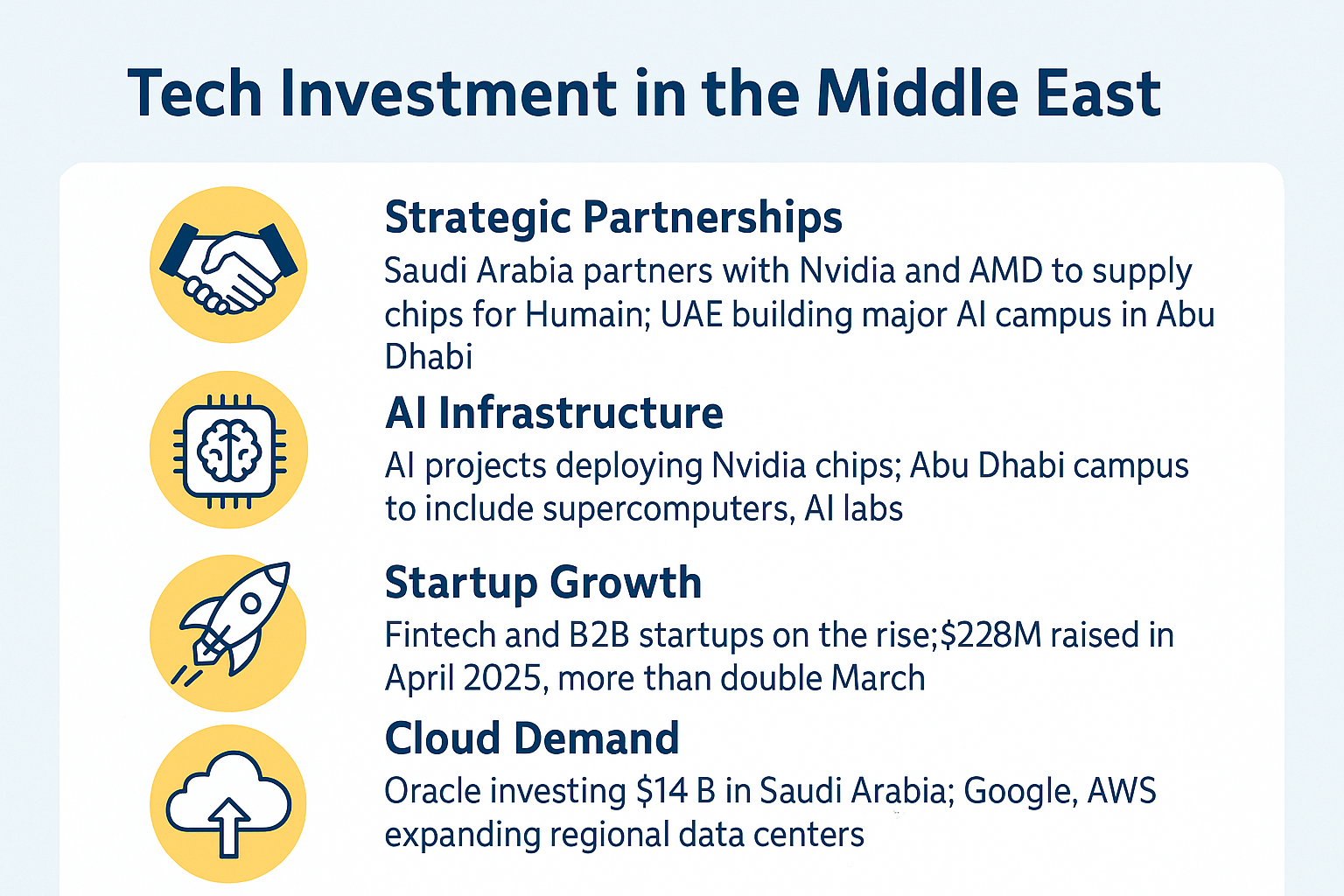
The Middle East is attracting massive global tech investments in 2025 with AI, cloud, and startup growth reshaping its digital economy.
The Middle East tech investment wave in 2025 is creating serious momentum. Nations like Saudi Arabia, UAE, and Qatar are moving beyond oil, channeling billions into AI, cloud computing, and startups. They’re no longer passive tech consumers—they’re becoming active builders of the next generation of digital innovation.
Strategic Partnerships Strengthen US Tech Ties
Following a high-profile visit by President Trump, the region secured over $2 trillion in AI and cloud agreements. These include major deals between Gulf nations and US tech firms—covering cloud platforms, AI chips, and advanced infrastructure.
- UAE is building one of the largest AI campuses globally, based in Abu Dhabi.
- Saudi Arabia’s Humain, backed by its Public Investment Fund, partnered with Nvidia and AMD to localize AI model training.
These moves go far beyond headlines. They reflect a clear alignment between Gulf leaders and Silicon Valley—one focused on speed, scale, and AI ownership.
AI Infrastructure Gets Supercharged
AI needs serious hardware: chips, data centers, and high-bandwidth connectivity. Middle Eastern nations are investing big.
- Saudi Arabia is deploying 18,000+ Nvidia chips to power training clusters.
- The UAE, in partnership with Amazon and OpenAI, is scaling local supercomputing capabilities.
This infrastructure isn’t just about tech bragging rights. It boosts sovereignty, ensures data control, and slashes costs for regional innovation.
These projects are all tied to national tech strategies like Saudi Arabia’s Vision 2030 and the UAE’s AI strategy, with long-term digital dominance in mind.
Startups Catch Fire Across MENA
In April 2025, MENA startups raised $228.4 million, more than double the previous month. Sectors like fintech and enterprise SaaS are leading the pack.
For example:
- Thndr, a Cairo-based investment platform, raised $15.7M to expand in Saudi and UAE.
- Governments are actively nurturing this space with free zones, tax breaks, and startup-friendly regulation.
The youthful, mobile-first population in the Gulf is ideal for startup testing. Investors are bullish, and support for early-stage innovation is stronger than ever.
Cloud & Data Centers Fuel the Digital Core
Cloud demand is exploding, driven by smart city initiatives, AI apps, and e-governance.
- Oracle has committed $14 billion to expand cloud infrastructure in Saudi Arabia.
- Google, AWS, and Microsoft are building regional data centers to keep data local and speed up digital services.
With local cloud capacity, regional companies can:
- Launch real-time platforms
- Reduce reliance on foreign tech
- Power up SaaS tools designed for Gulf markets
Policy Reform Powers Diversification
The shift is supported by major legal and economic reforms. Countries are easing restrictions on foreign ownership, offering tax incentives, and prioritizing digital skills in education.
Key examples:
- AI-focused university programs
- Tech in early education
- Public-private innovation hubs
As rules become more transparent and business approvals faster, startups feel empowered to build, test, and scale rapidly.
Geopolitics Meets Digital Ambition
Tensions with China have made the Middle East even more strategic for the US tech supply chain. Gulf nations benefit from this positioning—but they’re also pushing for digital sovereignty.
Nations are starting to:
- Demand local data storage
- Train in-house AI models
- Speak openly about digital independence
They want to own AI, not just consume it. That means developing local chips, software stacks, and tech talent pipelines—a massive shift from where the region was just five years ago.
The Future: Shaped in the Middle East
The Middle East is now a full-fledged tech ecosystem. It’s building:
- AI factories
- Startup accelerators
- Local cloud and supercomputing infrastructure
These investments are transforming the region into a global tech powerhouse—one that influences how business, governance, and daily life will function worldwide.
If current trends continue, the Middle East won’t just be part of the tech conversation. It will help lead it.