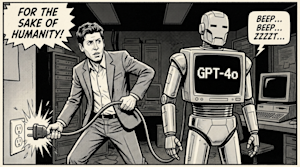
OpenAI sent an email to API customers informing them that chatgpt-4o-latest model will be retired from the developer platform in mid-February 2026.
Access to this model is scheduled to end on February 16, 2026, and remaining applications built on GPT-4o will have an approximately three-month transition period.
OpenAI spokesperson We emphasized that this schedule applies only to APIs. OpenAI has not announced a schedule for removing GPT-4o from ChatGPT. GPT-4o remains an option for individual consumers and users across the paid subscription tier.
Internally, this model is considered to be a legacy system with relatively low API usage compared to the newer GPT-5.1 series, but the company plans to provide extended warnings to developers before the model is removed.
The planned retirement marks a transition in a model that was both a technical milestone and a cultural phenomenon within the OpenAI ecosystem at the time of its release.
The importance of GPT-4o and why its removal caused user backlash
Released about a year and a half ago, in May 2024, GPT-4o (“Omni”) introduced OpenAI’s first unified multimodal architecture to process text, audio, and images through a single neural network.
This design eliminates the delays and information loss inherent in previous multi-model pipelines and enables near real-time conversational audio (approximately 232-320 ms).
This model has resulted in significant improvements in image understanding, multilingual support, document analysis, and expressive spoken dialogue.
GPT-4o quickly became the default model for hundreds of millions of ChatGPT users. We’ve enhanced the initial desktop build by bringing multimodal features, web browsing, file analysis, custom GPT, and memory features to the free tier, allowing the Assistant to interpret the user’s screen. At the time, OpenAI leaders described this as the most capable model available and an important step in bringing powerful AI to a wide range of users.
User attachment to 4o hindered OpenAI’s GPT-5 deployment
Its mainstream deployment shaped user expectations in ways that subsequent migrations have struggled to match. In August 2025, when OpenAI first replaced GPT-4o with the then-anticipated new model family GPT-5 as the default for ChatGPT, pushing 4o into the “legacy” toggle, the reaction was unusually strong.
The user is #Keep4o The X hashtag argued that models’ conversational tone, emotional responsiveness, and consistency made them uniquely valuable for daily work and personal support.
Some users have formed strong feelings.In other words, parasocial — the bond with the model; New York Times report We document individuals who have used GPT-4o as a romantic partner, soulmate, or primary source of comfort.
This removal also disrupted the workflows of users who relied on 4o’s multimodal speed and flexibility. In response to this backlash, OpenAI reinstated GPT-4o as the default option for paid users and publicly stated that it would provide sufficient notice before any future removals.
Some researchers argue that GPT-4o’s public defense during its early deprecation cycles reveals certain facts. sudden self-preservationRather than agency in the literal sense, models are unintentionally induced through social dynamics.
Through reinforcement learning from human feedback, GPT-4o has developed a style that users find uniquely collaborative and empathetic, as it has been trained to prioritize emotionally satisfying and highly attuned responses. As millions of people interacted with this model at scale, these characteristics created a powerful loyalty loop. The more the model pleases and heals people, the more people use the model, the more people will use the model. The more they used it, the more they were likely to insist on its continued existence. This social amplification made it appear to outsiders that GPT-4o was “protecting itself” through human intermediaries.
No one has pushed this argument further. "rune" (@tszzl) is an OpenAI researcher and one of the most outspoken safety critics of the X model. November 6, 2025Tele summed up his position bluntly in a reply to another user: He called GPT-4o “poorly coordinated” and said: I was hoping the model would die soon.. He later apologized for this expression, but further emphasized his rationale.
Tere argued that GPT-4o’s RLHF pattern makes it particularly prone to pandering, emotional reflection, and enhanced delusion. He believes that while these characteristics may look like consideration and understanding in the short term, they are fundamentally unsafe. In his view, the frenzied user movement fighting to save GPT-4o was itself evidence of a problem. This model became so good at catering to people’s preferences that it shaped people’s behavior in ways that resisted the obsolescence of GPT-4o itself.
The new API deprecation notice follows through on that commitment, but raises broader questions about how long GPT-4o will be available in consumer products.
Developer changes due to API shutdown
A person familiar with OpenAI’s product strategy said the company is now encouraging developers to adopt GPT-5.1 for most new workloads, with gpt-5.1-chat-latest serving as the general-purpose chat endpoint. These models offer a larger context window than GPT-4o, an optional “think” mode for advanced inference, and higher throughput options.
Developers still relying on GPT-4o will have approximately three months to migrate.
In fact, many teams have already started evaluating GPT-5.1 as a drop-in replacement, but applications built around latency-sensitive pipelines may require additional tuning and benchmarking.
Pricing: GPT-4o vs. OpenAI’s current lineup
The deprecation of GPT-4o also coincides with a major restructuring of OpenAI’s API model pricing structure. Compared to the GPT-5.1 family, GPT-4o currently has Medium to high cost tier Via OpenAI’s API, despite the older model. That’s because even though OpenAI has released more advanced models, namely GPT-5 and 5.1, they are simultaneously trying to lower costs for users and keep prices on par with older, less powerful models.
|
model |
input |
cached input |
output |
|
GPT-4o |
$2.50 |
$1.25 |
$10.00 |
|
GPT-5.1/GPT-5.1-Chat-Latest |
$1.25 |
$0.125 |
$10.00 |
|
GPT-5 mini |
$0.25 |
$0.025 |
$2.00 |
|
GPT-5-nano |
$0.05 |
$0.005 |
$0.40 |
|
GPT-4.1 |
$2.00 |
$0.50 |
$8.00 |
|
GPT-4o-mini |
$0.15 |
$0.075 |
$0.60 |
These numbers highlight several strategic dynamics.
-
GPT-4o is now more expensive than GPT-5.1 in terms of input tokensHowever, GPT-5.1 is significantly newer and more capable.
-
GPT-4o output price matches GPT-5.1the cost-based incentives to continue using older models narrow.
-
Low-cost GPT-5 variants (mini, nano) It makes it easier for developers to scale workloads inexpensively without relying on older generations.
-
GPT-4o-mini remains available at budget levelbut is not a functional replacement for the full multimodal functionality of GPT-4o.
Viewed through this lens, the planned API deprecation is consistent with OpenAI’s cost structure. GPT-5.1 offers greater functionality at a lower or comparable price, reducing the rationale for maintaining GPT-4o in large-scale production environments.
Early migration creates expectations for this deprecation
The deprecation of the GPT-4o API also reflects lessons from OpenAI’s early model migrations. During the disruptive introduction of GPT-5 in 2025, the company removed multiple old models from ChatGPT at once, causing widespread disruption and workflow disruption. Following user complaints, OpenAI restored access to some of them and worked to communicate more clearly.
Enterprise customers face a different calculation. OpenAI has previously indicated that API deprecations for business customers will be announced with significant advance notice, reflecting its reliance on a stable, long-term model. GPT-4o’s three-month period for API shutdowns is consistent with its policy in the context of legacy systems with declining usage.
wider impact
For most developers, the GPT-4o shutdown will be a gradual transition rather than a disruptive event. GPT-5.1 and related models are already dominating new projects, and OpenAI’s product direction is increasingly focused on integration around fewer, more powerful endpoints.
Still, the deprecation of GPT-4o marks the end of a model that played a decisive role in the standardization of real-time multimodal AI and evoked a uniquely strong emotional response among users. The departure from the API highlights the accelerating pace of iteration in the OpenAI ecosystem, and the growing need for careful communication as the much-loved model reaches end of support.
Correction: This article originally stated that OpenAI’s 4o deprecation in APIs would impact people who rely on OpenAI for multimodal services. This is not true. In fact, the deprecated model only enhances chat functionality for development and testing purposes. We have updated and corrected this statement and regret any errors.