Tether has partnered with the United Nations Office on Drugs and Crime to strengthen cybersecurity and combat digital asset fraud in Africa, Papua New Guinea, and other vulnerable regions.
The partnership, announced Friday, will fund victim protection programs, youth education initiatives, and blockchain-based solutions to reduce exploitation and build community resilience against organized crime.
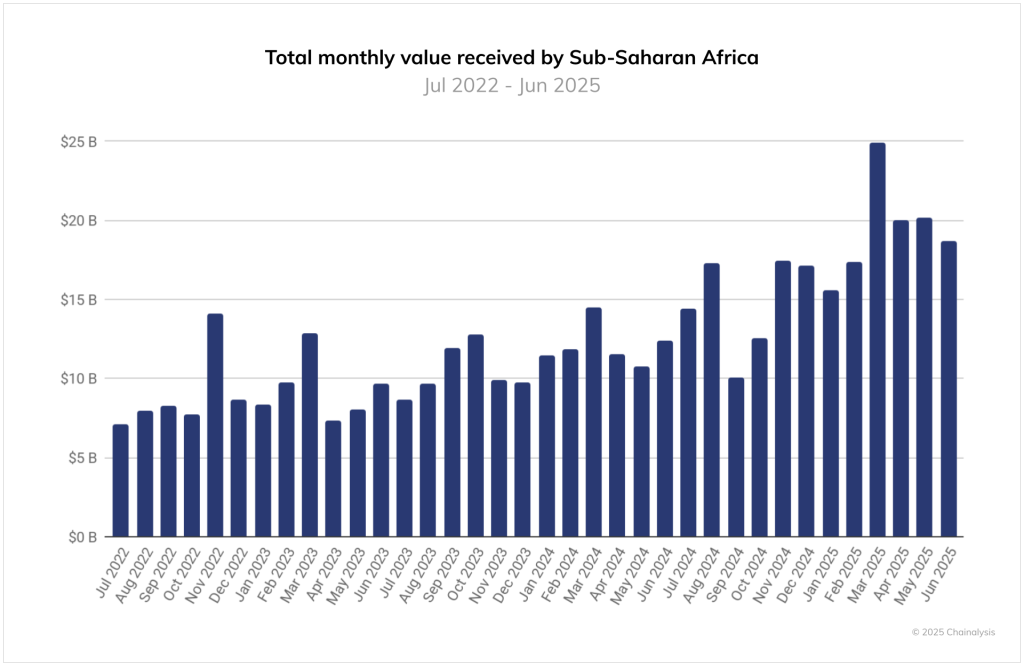
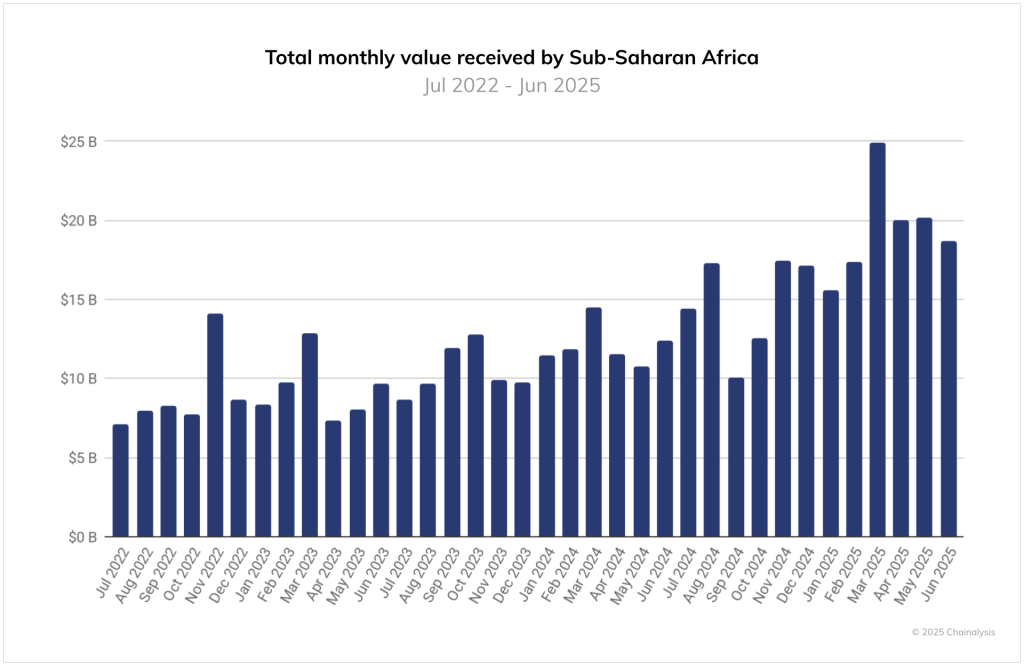
According to Chainalysis, Africa has emerged as the third fastest growing crypto region with transaction volumes exceeding $205 billion from July 2024 to June 2025, but it has also become a major target for fraud and human trafficking.
A recent Interpol investigation referenced by Tether revealed $260 million in illicit cryptocurrency and fiat currency circulation across the continent.
Protecting victims while educating future innovators
This partnership supports UNODC’s Africa 2030 Strategic Vision, which focuses on three core initiatives across multiple countries:
In Senegal, Tether will fund a multi-stage cybersecurity education program for youth, including boot camp sessions led by the Plan B Foundation (a joint project between Tether and the City of Lugano), followed by coaching, mentorship and micro-grants to help participants develop their ideas.
The initiative will provide funding to civil society organizations that provide direct support to victims of human trafficking across six African countries, including Nigeria, Democratic Republic of the Congo, Malawi, Ethiopia, and Uganda.
In Papua New Guinea, Tether will work with local universities to raise awareness about financial inclusion and digital asset fraud prevention through a student competition focused on blockchain solutions for crime prevention.
Tether CEO Paolo Ardoino said the partnership combines innovation and education to create safer opportunities for vulnerable communities.
“Through our collaboration with the United Nations Office on Drugs and Crime, we support efforts that combine innovation and education to empower communities and create safer and more inclusive opportunities for those most in need.” Ardoino said.
Sylvie Bertrand, UNODC Regional Director for West and Central Africa, said the cooperation was a tripartite initiative.Bringing together the UN, private sector and Senegalese authorities to support the vision behind Senegal’s Digital New Deal,” while promoting a secure digital ecosystem and preventing organized crime.
From executive partner to development ally
The partnership marks a shift in Tether’s relationship with UN agencies, moving from coordination primarily focused on law enforcement to active development work.
According to blockchain forensics firm AMLBot, Tether froze $3.3 billion across 7,268 wallet addresses from 2023 to 2025 while working with more than 275 law enforcement agencies in 59 jurisdictions.
The company’s enforcement model includes burning seized tokens and reissuing clean replacements to victims, and it has processed up to $2.7 billion in stolen funds.
Tether and Circle froze $3.3 billion and $109 million of cryptocurrencies over three years, demonstrating the vast differences in how the two largest stablecoin issuers police illicit funds.#USDT #USDC #tether #circlehttps://t.co/iaWt2lU8Oh
— Cryptonews.com (@cryptonews) December 10, 2025
Key measures included freezing $130 million in July 2024, of which $30 million was related to Cambodia’s Huione Group. The Fuione Group is a platform that has processed more than $24 billion in suspected criminal cryptocurrency flows since 2021 and operated an unlicensed exchange, an identity fraud service, and its own stablecoin.
The United Nations has previously warned that organized crime groups are increasingly using stablecoins, especially USDT on low-cost networks like Tron, to fund terrorism, human trafficking and fraud across Southeast Asia and other regions.
A 2024 UNODC report estimates that fraud originating from East and Southeast Asia will result in losses of between $18 billion and $37 billion in 2023 alone, with much of the activity denominated in USDT.
Criminal networks have exploited the liquidity and global influence of cryptocurrencies to facilitate sophisticated pig-butchering scams that manipulate victims to extract large sums of money through illegal online gambling, identity theft operations, and fake romantic relationships.
The new partnership comes amid continued broader cryptocurrency security threats, with losses from hacks and exploits totaling $76 million in December, down 60% from $194 million in November.
Single-address poisoning scams accounted for $50 million in losses in December, but social engineering attacks continue to target users across major platforms, including the recent incident at Betterment and widespread wallet exfiltration across the Ethereum virtual machine compatible network.
The new partnership focuses on prevention and education rather than enforcement, but builds on Tether’s infrastructure developments, including the recent launch of Rumble Wallet (a self-custodial crypto wallet that supports USDT, Bitcoin, and Tether Gold) and an $8 million investment in Speed, a Bitcoin Lightning Network payments company.
Tether and Rumble have launched Rumble Wallet, a self-custodial cryptocurrency wallet.#tether #cipherhttps://t.co/sfY0D6K1MX
— Cryptonews.com (@cryptonews) January 7, 2026
Earlier this week, the company also introduced Scudo, a new unit of Tether Gold designed to make gold-backed digital assets more accessible in everyday transactions.
The article UN leverages Tether to fight crypto fraud and human trafficking was first published on Cryptonews.