
Important points:
- The new ETF proposal is Bitcoin is only for one nightbuy after the US market closes and sell when it opens.
- Bloomberg’s Eric Balchunas says: Historically most of BTC’s profits occur after hoursthis idea could be profitable.
- This application signals the arrival of a new phase A highly specialized crypto ETF This is because publishers are experimenting beyond simple spot exposure.
A new ETF application built on Bitcoin’s overnight performance is currently circulating in US regulatory channels, marking one of the most unconventional strategies introduced since the Spot Bitcoin ETF began operations earlier this year. This product seeks to exploit a pattern that has been observed for many years. This means that Bitcoin often performs better when traditional markets are closed.
Below is a breakdown of the strategy, the market context, and why ETF issuers are increasingly turning to niche timing-based designs.
Night-only Bitcoin ETF attracts attention
Bloomberg Senior ETF Analyst Eric Balchunas Flagged application in Xnoted that the proposed ETF would buy Bitcoin after the U.S. stock market closes and exit those positions before the market reopens. This approach effectively limits exposure to a narrow window that has historically captured disproportionate upside.
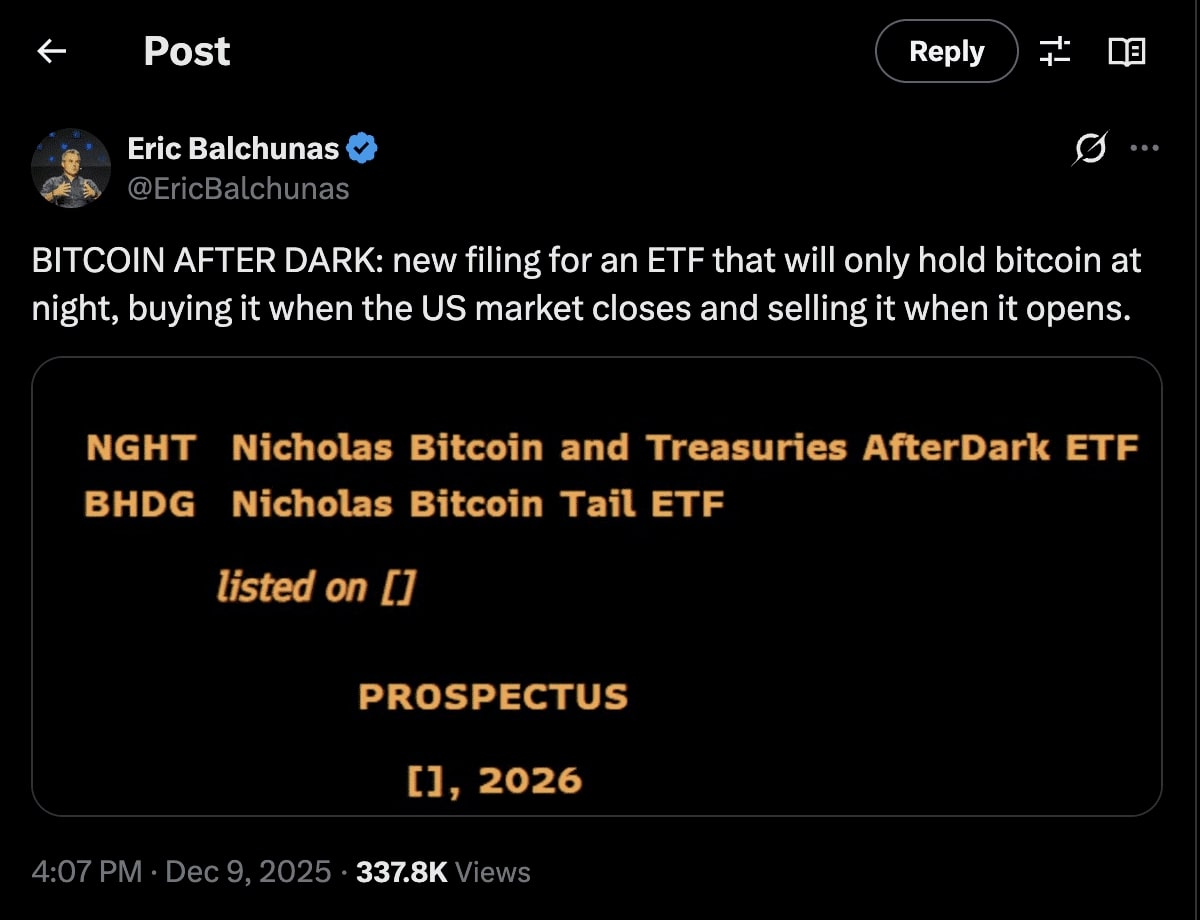
Balciunas commented that a study last year revealed that. Most of Bitcoin’s rise happens overnight. He added that while ETFs influence price trends, the pattern persists across cycles, likely due to activity concentrated in global flows, derivatives positioning, and the overlap of Asian and European trades.
He also emphasized that the application is part of a broader trend.
“The ETF industry is going to try everything imaginable… so we can get the next big thing.”
This strategy reflects a combination of creative product engineering and competition in a crowded ETF environment where issuers seek differentiated sources of alpha.
Read more: Vanguard opens up to crypto ETFs, opening access to 50 million investors, reversing long-standing policy

Why overnight Bitcoin exposure matters
Bitcoin transaction structure pattern
Bitcoin is traded 24/7, but liquidity and trading behavior vary from region to region. Historical datasets repeatedly show that:
- Night sessions outperform day sessionsespecially in Asia and early European times.
- US trading hours often see consolidation or retrace of previous movements.
- Derivatives trading, especially on global exchanges, remains active outside of U.S. market hours.
According to analysis cited in previous ETF filings, Bitcoin’s average overnight returns were significantly higher than returns during the standard trading window in the United States. The proposed ETF seeks to mechanize this pattern into a systematic strategy.
This approach mirrors the structure found in traditional stocks, with “night effect” ETFs attempting to isolate the after-hours returns of major indexes such as the S&P 500. The difference here is that the 24/7 nature of Bitcoin makes timing effects even more pronounced and potentially more profitable.
ETF issuers are going beyond simple spot exposure
The Spot Bitcoin ETF was launched in early 2024 and quickly surpassed $100 billion in total assets. With most issuers now offering nearly identical exposure, strategies are starting to splinter into:
- timing-based ETFs (Like the After Dark concept)
- Volatility managed Bitcoin ETF
- Tail risk hedged Bitcoin fund
- Bitcoin + Treasury Rotation Model
- A factor-style crypto ETF inspired by the stock market
The new filing falls squarely into this next phase, which Balciunas describes as “capitalism in action,” as issuers aggressively iterate to find products that will interest investors.

Market data still shows Net worth over $118 billion Despite inflows slowing due to the fall in BTC, US Bitcoin ETFs overall are increasing. This has led publishers to look for strategies that offer more than just exposure.
Read more: Bitwise confirms launch date for XRP ETF to trade on NYSE in major crypto milestone
How to operate an after dark ETF
Although the filing did not fully detail the composition of the financial product, the Overnight Bitcoin ETF typically relies on:
- US-listed Bitcoin futures Supports flexible exposure
- Spot Bitcoin ETF as a tradable underlying asset
- Bitcoin index options To fine-tune the exposure
- short-term government bonds during the day to preserve capital
The proposed product would not directly hold spot Bitcoin and would be in line with existing regulatory frameworks that prioritize regulated derivatives over direct custody of cryptocurrencies.
Because ETFs rotate their positions daily, their trading volume is high. This creates execution risk and slippage, making it effective. In other words, performance depends on how effectively managers enter and exit positions on a cycle basis.
The filing comes at a time when Bitcoin is trading around the low $90,000 range after continued pressure in October and November. Although ETF flows have slowed, they remain net positive, suggesting institutional interest remains stable even as volatility subsides.