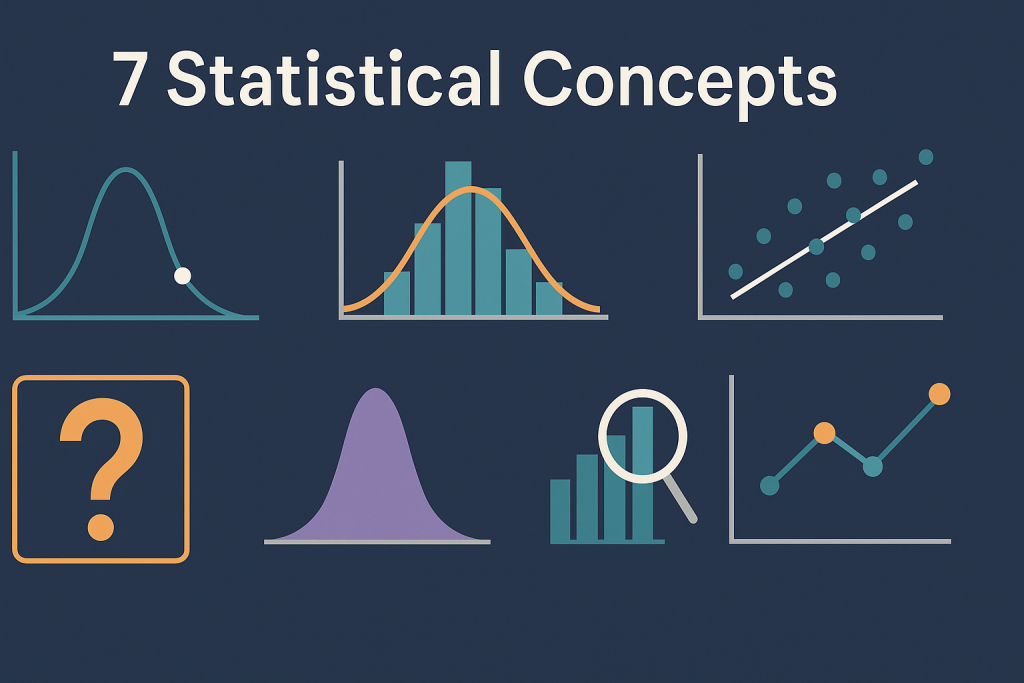
7 statistical concepts you need to succeed as a machine learning engineer
Image by editor
introduction
When we ask ourselves, “What’s inside a machine learning system?“Most of us think of frameworks and models that make predictions or perform tasks, but few of us think through what’s really at the heart of it. statistics — A toolbox of models, concepts, and methods that enable systems to learn from data and perform their jobs reliably.
For machine learning engineers and practitioners, understanding key statistical ideas is essential for interpreting data used with machine learning systems, validating assumptions about inputs and predictions, and ultimately building trust in these models.
Given the role of statistics as a valuable compass for machine learning engineers, this article describes seven core pillars that anyone in this role should know, not only to succeed in interviews, but to build reliable and robust machine learning systems in their daily work.
7 important statistical concepts for machine learning engineers
Without further ado, here are seven foundational statistical concepts that should be part of your core knowledge and skill set.
1. Basics of probability
Virtually all machine learning models, from simple classifiers based on logistic regression to state-of-the-art language models, have a probabilistic foundation. Therefore, a solid understanding of random variables, conditional probability, Bayes theorem, independence, joint distribution, and related ideas is essential. Models that make intensive use of these concepts include naive Bayes classifiers and hidden Markov models for tasks such as spam detection. Sequence prediction and speech recognitionand the probabilistic inference component of the transformer model Estimate the likelihood of tokens and generate consistent text.
bayes theorem It’s a natural starting point as it spans the entire machine learning workflow, from missing data imputation to model tuning strategies.
2. Descriptive and inferential statistics
Descriptive statistics provides basic metrics for summarizing the properties of your data, including common metrics such as mean and variance, and metrics important for data-intensive work such as skewness and kurtosis, which help characterize the shape of the distribution. meanwhile, inferential statistics It involves how to test hypotheses and draw conclusions about a population based on a sample.
The practical uses of these two subdomains are widely used throughout machine learning engineering. Hypothesis testing, confidence intervals, p-values, and A/B testing are used to evaluate models and operational systems and to interpret the effects of features on predictions. That’s a strong reason for machine learning engineers to have a deep understanding of machine learning.
3. Distribution and sampling
Different datasets exhibit different characteristics, a clear statistical pattern or shape. Understand and differentiate between distributions such as the normal, Bernoulli, binomial, Poisson, uniform, and exponential distributions, and identify which one is appropriate for you. modeling or simulation Data is important for tasks such as bootstrapping, cross-validation, and uncertainty estimation. Closely related concepts like Central Limit Theorem (CLT) and law of large numbers is fundamental to Evaluating reliability and convergence of model estimation.
As an additional tip, make sure you understand the following: tail and distortion This makes detecting problems, outliers, and data imbalances much easier and more effective.
4. Correlation, covariance, and feature relationships
What becomes clear from these concepts is that how variables move together — What tends to happen to a variable when it increases or decreases. Everyday machine learning engineering informs feature selection, multicollinearity checking, and dimensionality reduction techniques such as principal component analysis (PCA).
Additional tools are required because not all relationships are linear. Examples include Spearman rank coefficients for monotonic relationships and methods for identifying nonlinear dependencies. Good machine learning practices start with a clear understanding of which features in your dataset are truly important to your model.
5. Statistical modeling and estimation
Statistical models approximate and represent aspects of reality by analyzing data. The core concepts of modeling and estimation, such as bias-variance trade-off, maximum likelihood estimation (MLE), and ordinary least squares (OLS), are: Training (fitting) the model, tuning hyperparameters Optimize performance and avoid pitfalls such as: overfitting. Understanding these ideas reveals how models are built and trained, revealing surprising similarities between simple models like linear regressors and complex models like neural networks.
6. Experimental design and hypothesis testing
Closely related to inferential statistics, but going a step further, experimental design and hypothesis testing ensure that improvements result from genuine signals rather than chance. Rigorously examine model performance, including control groups, p-values, false discovery rates, and power analysis.
A very common example is: A/B testingis widely used in recommender systems to compare a new recommendation algorithm with the production version and decide whether to roll it out. Think statistically from the beginning. Think before you collect data for tests and experiments, not after.
7. Resampling and evaluation statistics
The final pillar includes resampling and evaluation approaches such as permutation tests, as well as cross-validation and bootstrapping. These techniques are used with model-specific metrics such as accuracy, precision, and F1 score, and the results should be interpreted as statistical estimates rather than fixed values.
The key insight is that metrics vary. Approaches like confidence intervals often provide better insight into model behavior than a single numerical score.
conclusion
When machine learning engineers have a deep understanding of the statistical concepts, techniques, and ideas described in this article, they can not only tune models, but also interpret results, diagnose problems, and explain behavior, predictions, and potential problems. These skills are a big step towards trustworthy AI systems. To strengthen your intuition, consider reinforcing these concepts with small experiments and visual explorations in Python.